
Case Study: CNC to Additive — Chemical-Resistant Nylon 12 Spacers at ~75% Savings
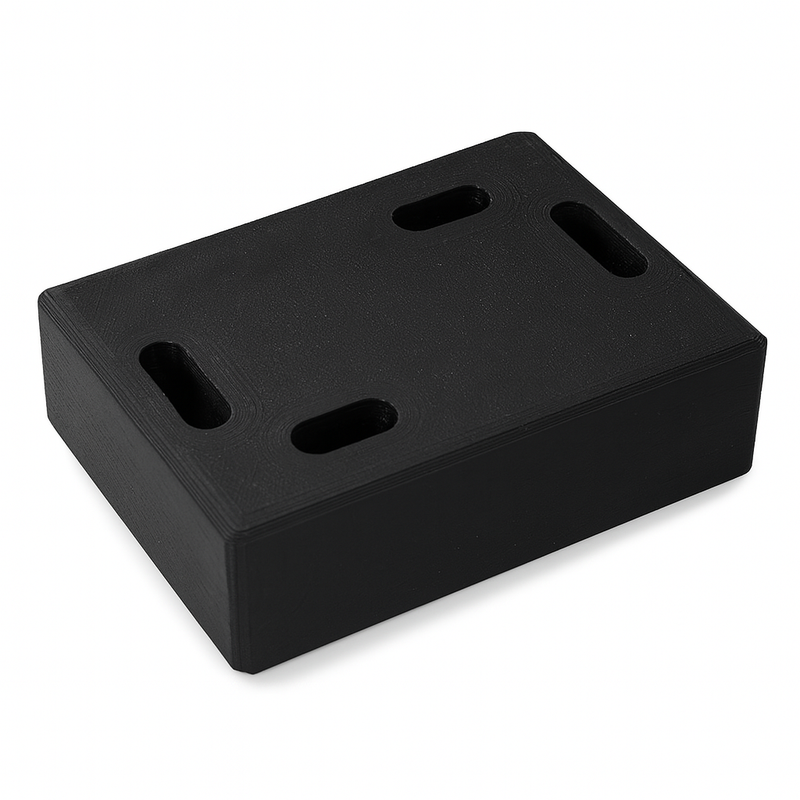
Spacers are the quiet overspend of machined bills of material. Simple geometry, modest requirements, real chemical exposure — and a CNC price that carries setup, programming, and queue time the part never asked for. This program converted a chemical-resistant spacer from CNC machining to additive manufacturing in Nylon 12, at approximately 75% lower cost per part.
The Situation
The component is an industrial spacer with one non-negotiable requirement: chemical resistance in service. It had always been CNC machined — a reasonable default, but an expensive one for a part whose geometry is fundamentally simple. Every order carried machining setup and programming overhead, and the per-part price reflected the process, not the part.
Why Nylon 12
Nylon 12 is the chemistry-facing workhorse of the polyamide family: strong chemical resistance, low moisture absorption compared to other nylons (which means better dimensional stability in wet or chemically active environments), and natural toughness suited to a component that lives between harder parts. It met the spacer's actual requirements — chemical survival, dimensional consistency, functional strength — without the machining process premium.
The Results
| CNC Machined | Printed Nylon 12 | |
|---|---|---|
| Cost per part | Baseline | ~75% lower |
| Setup & programming per order | Every run | None — validated file goes straight to the fleet |
| Chemical resistance | Met | Met — inherent to Nylon 12 |
| Reorder path | Re-quote, re-setup, shop queue | Locked parameters, printed in parallel, ~1 week |
The Pattern Worth Noticing
The 75% didn't come from clever engineering — it came from removing a mismatch. Machining priced this part on setups and spindle time; printing prices it on material and machine hours, which is what simple-geometry, moderate-requirement parts actually consume. Spacers, bushings, standoffs, washers-with-features, and guide blocks across a machined BOM tend to share this profile — and they're often the fastest 50–75% a sourcing manager will ever find. This is the same logic as our five-operations-to-zero ASA mounting component program (~60% savings), applied to a different material requirement.
Honest Boundaries
Not every machined spacer converts: metal-on-metal crush loads, sustained heat approaching 150°C, or true precision-ground faces keep a part in metal, and we say so in the quote. The candidates are parts whose requirements are functional — chemical, dimensional, moderate-load — rather than at the edge of what metal provides.
Find Yours
Send us the machined line items on your BOM that feel too expensive for what they are — CAD plus the service environment. We'll flag which convert, at what price, typically within one business day. Related: low volume production, jigs & fixtures, and the full capabilities sheet.
FAQ
Why was the printed version 75% cheaper?
Machining prices simple parts on setup, programming, and spindle time; printing prices them on material and machine hours. For simple-geometry parts with functional (not precision-ground) requirements, removing the process overhead is where most of the savings comes from.
Is printed Nylon 12 really chemically resistant?
Nylon 12 offers strong resistance across many industrial chemistries with low moisture uptake for a polyamide — which is exactly why it was selected here. Specific chemical compatibility is checked against your actual service exposure during quoting; datasheets available on request.
What other machined parts fit this conversion profile?
Spacers, bushings, standoffs, guide blocks, and simple brackets — parts whose geometry is simple and whose requirements are functional rather than at metal's limits. Multi-operation machined parts with moderate loads see the biggest deltas.
Chatelet Manufacturing is a US-based contract manufacturer in the Orlando, Florida area, operating 85+ FDM production printers. We produce carbon fiber nylon, glass filled nylon, ASA, polycarbonate, PETG, and TPU parts from prototype through low-volume production, with turnaround as soon as one week depending on part complexity and volume.